
Weddings often bring families together, but they can also expose hurt feelings that have been quietly building for months.
When one couple is excluded from a celebration, it can leave lasting questions about respect, priorities, and whether those decisions should be remembered when it’s someone else’s turn to send out invitations.
The original poster (OP) was excited to support his stepsister on her wedding day, even after learning that his own fiancée had not been invited.
At first, he tried to give her the benefit of the doubt, assuming there was a reasonable explanation.
However, what he discovered during the wedding left him feeling far more hurt than he expected and now has him questioning how to handle his own guest list.
Scroll down to read the full story.
Groom questions one wedding invitation after feeling excluded from another














































Every family celebration carries invisible expectations. Weddings, in particular, are rarely just about flowers, vows, or guest lists.
They often become emotional mirrors, reflecting who feels valued, included, and remembered.
When someone believes they have poured years of love, loyalty, and support into a relationship, even a seemingly small decision can feel like a profound rejection.
In this story, the groom-to-be wasn’t simply debating a wedding invitation. He was wrestling with the painful realization that someone he considered a younger sister may not have valued their relationship in the same way.
That emotional disconnect can leave a wound that lingers long after the event itself.
The conflict is less about one missing plus-one and more about broken expectations.
The OP had stood beside his stepsister through difficult moments in life, watched her grow up, and viewed her as immediate family.
Learning that his fiancée was excluded despite ample space and resources transformed confusion into hurt.
His instinct to exclude her husband from his own wedding is understandable because people often seek balance after experiencing unfairness.
Psychologically, reciprocity feels deeply connected to justice.
Yet this situation also reveals an important tension: the desire to protect one’s future spouse while resisting the temptation to repeat the same painful pattern.
While many readers see revenge, others may recognize something more complicated.
Sometimes people aren’t trying to “get even”; they’re trying to regain a sense of dignity after feeling dismissed.
 Teacher Replaces A Student’s Meaningful Name With “Katherine,” Then Gets The Same Treatment Back
Relationship experts frequently point out that healthy boundaries and retaliation are not the same thing.
According to licensed therapists interviewed by Verywell Mind, boundaries exist to protect emotional well-being and foster mutual respect, not to create winners and losers.
They emphasize that healthy limits communicate personal values while preserving the possibility of respectful relationships, even when disagreements remain.
Rather than acting as punishment, boundaries clarify what someone needs in order to feel emotionally safe.
Viewed through that lens, the real question shifts. Instead of asking whether excluding the husband would be fair, the more meaningful question becomes whether doing so actually serves the couple’s long-term goals.
If the invitation is motivated by protecting the emotional atmosphere of their wedding day, it functions as a boundary.
If it is primarily intended to make the stepsister experience the same hurt they once felt, it becomes retaliation.
Those motivations may appear similar on the surface, but psychologically they lead to very different emotional outcomes.
One creates clarity; the other often extends resentment without providing real closure.
Perhaps the healthiest takeaway is that weddings should reflect the future a couple hopes to build rather than the pain they’ve experienced.
Family relationships may never feel perfectly balanced, and not every hurt receives an apology. But making decisions that align with personal values rather than emotional scorekeeping often brings a greater sense of peace.
It’s a difficult distinction, and one that many readers will likely see differently depending on their own experiences with family loyalty, disappointment, and forgiveness.
Check out how the community responded:
These Redditors agreed Niki is the real problem and shouldn’t be invited, with many saying her husband shouldn’t be punished for her actions































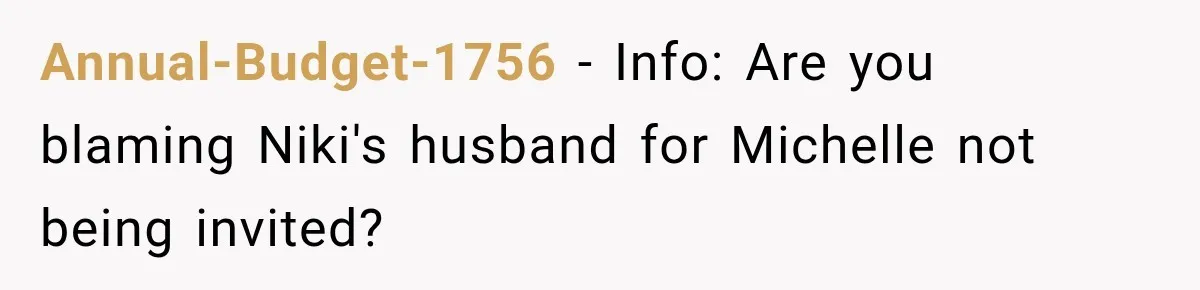
These users questioned whether OP had talked to Niki first and urged communication before making a final decision





In the end, this story isn’t really about wedding invitations, it’s about reciprocity, respect, and whether family relationships should be held to the same standards we expect from everyone else.
The OP felt hurt after his fiancée was excluded without a clear reason, especially after years of supporting his stepsister through difficult times.
While some readers felt matching the same invitation policy was fair, others warned it could deepen an already painful family rift.
Do you think the OP would be justified in leaving his stepsister’s husband off the guest list, or is it better to break the cycle and extend the invitation anyway?
Share your thoughts in the comments!